
What Levi’s FIFA Moment Teaches About Brand Narrative Control
By BrandingSchool.NG
June 15, 2026
Advertisement
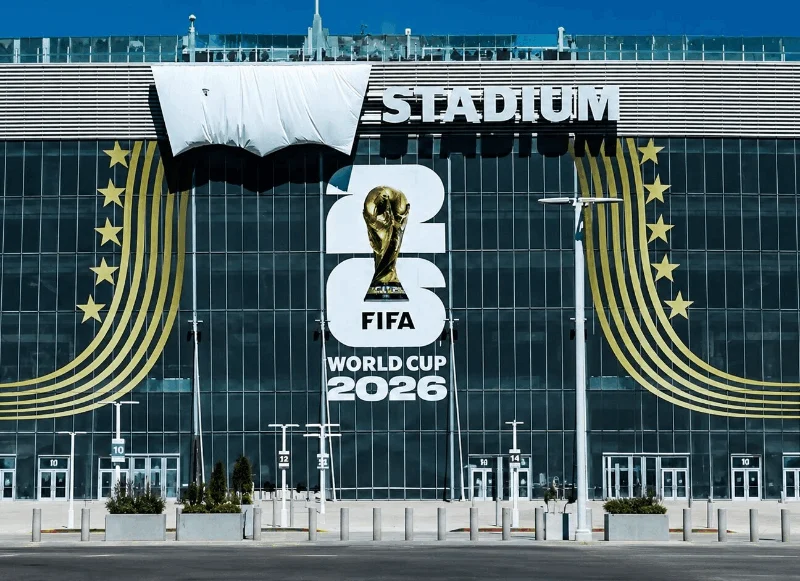
Imagine spending $170 million to put your name on a building. Then imagine someone covering that name with a white tarp, right as three billion people are watching the building on television. And then imagine that your brand stays visible anyway, and your brand narrative control is so strong that the whole world is talking about you, not the rule that tried to silence you.
That is exactly what happened to Levi’s at the 2026 FIFA World Cup. And it is one of the most instructive branding moments of this decade.
FIFA’s “clean venue” policy required every non-sponsor brand to be concealed at all World Cup host stadiums. Levi’s Stadium in Santa Clara, home of the San Francisco 49ers and host to six World Cup matches, became San Francisco Bay Area Stadium for the duration of the tournament. The iconic batwing logo, the one Levi’s pays $17 million per year to display, was covered with a white tarp.
And then something happened that no brand rule could have planned for.
The shape of the logo was still visible underneath the covering. That unmistakable batwing silhouette, recognizable to billions of people across 150 years of brand history, showed through the tarp. People noticed. Photographs went viral. And Levi’s, instead of issuing a corporate statement of grievance, changed their Instagram profile picture to the covered logo, posted videos of the shrouded stadium facade set to the trending audio “Nobody’s Gonna Know,” and captioned it: “Welcoming the world to the beautiful [redacted] stadium!”
The brand narrative control lesson embedded in that moment is one every Nigerian small business owner and creative needs to study. Not for the wit of the response. For what made the wit possible in the first place.
Table of Contents
This Is Not a Marketing Story. It Is a Brand Story.
Most of the coverage you have seen about Levi’s FIFA moment calls it clever marketing. A social media win. A PR masterclass.
That framing misses the point.
Marketing is what Levi’s did on Instagram. Brand is what made that marketing work. And the brand work happened decades before anyone planned a World Cup response campaign.
Think about what had to be true for this moment to land the way it did. The batwing had to be recognizable without the name. The logo shape had to carry so much stored recognition in the minds of billions of people that even a white tarp could not erase it. That kind of recognition is not an accident. It is the compounding output of years of consistent, deliberate, strategically managed brand expressions. It is what Brand Clarity looks like when it matures.
FIFA covered the name. They could not cover the brand. Because the brand does not live in the sign. It lives in the people who have seen that sign consistently enough that their minds can complete the picture without the full image.
That distinction is the lesson. And it runs deeper than a social media moment.
What Levi’s Did Right: Three Lenses, Three Verdicts
Lens 1: Leadership. They Moved With Clarity, Not Permission.
Levi’s did not wait for FIFA to give them a narrative. They did not go silent and hope the story died. They did not issue an official memo expressing “disappointment” at the policy. They moved fast, with confidence, in the same direction their brand has always moved.
That is leadership.
Building a brand is fundamentally a leadership activity. You are leading people from not knowing you, to knowing you. From knowing you, to trusting you. From trusting you, to choosing you. Leadership requires the courage to hold a position even when the conditions around you change. Levi’s did not reinvent their identity because FIFA covered their sign. They simply applied who they already were to a new situation.
The constraint did not create their response. Their brand clarity did.
Lens 2: Communication. They Turned Suppression Into a Conversation.
Here is what most brands in crisis mode do: they broadcast. They push out a message, defend a position, and measure nothing. There is no feedback loop. No invitation for the audience to participate. No mechanism for the exchange to become two-way.
Levi’s did the opposite.
They took the covered logo and made it a shared joke. They invited the audience in. “Nobody’s Gonna Know” was not a brand slogan. It was a cultural reference that every single person viewing the covered stadium was already thinking. Levi’s simply said out loud what the audience was silently feeling. The result was millions of people sharing, commenting, reposting, and turning the moment into a conversation that spread far beyond anything a paid campaign could have reached.
Branding is only effective when it is two-way. There is always a source, a recipient, and a feedback mechanism. Levi’s did not just send a message. They created a feedback loop. The evidence is in the engagement. That is measurable. That is what effective brand communication actually looks like.
Lens 3: Psychology. They Met the Audience Where the Audience Was.
People do not make decisions based on logic alone. They decide emotionally and justify rationally. When that white tarp went up, billions of people had one dominant feeling about it: amused irony. The absurdity of covering something so recognizable. The slight embarrassment of the policy backfiring. The shared satisfaction of everyone knowing what was underneath anyway.
Levi’s did not fight that feeling. They joined it.
That is human psychology applied to brand communication. They understood what the audience was experiencing and wrote their response in the language of that experience. It felt authentic because it was. The response was emotionally intelligent before it was strategically clever.
The Deeper Truth Nobody Is Saying Out Loud
Here is the insight only a trained brand strategist catches in this story.
A logo recognizable enough to be identified through a covering is not a marketing asset. It is a brand asset. And the difference between those two things is the work BrandingSchool.NG exists to help you understand.
Marketing assets can be bought. You can pay for a slot, a placement, a campaign. You can purchase visibility. But you cannot purchase the kind of recognition that makes a covered sign still identifiable to a global audience. That recognition can only be earned. It is built through the intentional, consistent application of your Brand Expressions over time.
Brand Expressions are the third of the Three Cardinals of Every Solid Brand. They are the personality, tone, visual language, and behavioural guardrails through which your Brand Core and Positioning are communicated to the world. The batwing is an expression. But the recognition it commands is a brand.
The batwing works because it has been applied consistently, correctly, and everywhere. On every jean, every store, every advertisement, every stadium facade, for over a century. No one changed the shape to follow a trend. No one refreshed it to look more contemporary. No one abandoned it when a new design direction felt exciting. They held it. Year after year. Season after season. And the market rewarded that consistency with something no one can cover with a tarp: stored recognition.
That is what brand clarity produces over time. That is what we teach at BrandingSchool.NG.
Now Look at Nigeria: The Selar vs. Mainstack Moment
In March 2026, Nigeria’s creator economy watched two of its most prominent platforms collide in public.
Mainstack hosted Moment 2026, a major creator conference at Lagos’ Landmark Event Centre, drawing over 4,000 attendees and positioning itself as the operating system for Africa’s digital creators. Selar, Mainstack’s closest rival, secured billboard space at the venue before the event and ran their own messaging directly at Mainstack’s audience. Classic ambush marketing. Mainstack removed the billboards. The story leaked onto X. Founder statements followed. Then came the added complexity of Selar’s former CMO being announced on stage as Mainstack’s new CMO.
In the days that followed, neither brand controlled what happened next. The story did not come from a coordinated brand response. It came from observers, journalists, industry commentators, and X threads. Both brands were being talked about. Neither brand was talking. And when they did speak, it was personal and reactive, not strategic and composed.
That is what happens when you do not have a brand narrative control framework in place before the moment arrives.
Levi’s could respond the way they did because they knew who they were. Their Brand Core, their Positioning, their Expressions: these were not things they were figuring out in the middle of a crisis. They were already settled. The clarity existed before the constraint appeared. So when FIFA covered the name, Levi’s brand response was not a scramble. It was a natural expression of something that had already been built.
Nigerian brands, including the best of them, consistently miss this. When the public moment arrives, the instinct is either silence or a personal statement that loses the brand in the founder’s frustration. The real issue is not the crisis management. It is the absence of brand clarity that would have made crisis management unnecessary.
When your brand is defined, you do not need a PR strategy for every difficult moment. The brand speaks because it already knows what to say.
What This Means for Your Business
You are not Levi’s. You are not managing a $170 million stadium naming deal. But you are managing the same fundamental equation, just at a different scale.
Every day, your brand is being perceived. By potential clients scrolling your Instagram, by existing customers sharing their experience on WhatsApp, by partners noticing whether what you said in your proposal matches how you behave in delivery. Those perceptions accumulate. They build into a stored impression. And when a difficult moment comes, that accumulated impression either gives you something to stand on or leaves you with nothing to hold.
The question is not whether something will happen that tests your brand. Something will. It always does. The question is whether your brand clarity will be deep enough by then that your response is a natural extension of who you already are, rather than a desperate attempt to manage a narrative you never owned in the first place.
Build your Brand Core. Get your Positioning right. Apply your Brand Expressions with the kind of consistency that makes your brand recognizable even when the conditions around you are trying to hide it.
Because if your brand is strong enough, you will not need to control the narrative. The narrative will naturally follow the brand you have already built.
That is the real Levi’s lesson.
The BrandGrowth Sprint is BrandingSchool.NG’s structured 3-month program for small business owners ready to build this kind of brand clarity, step by step, framework by framework, with accountability at every stage. When the next cohort opens, the details will be here first.
Filed under
Share this analysis
The Latest
Market Watch · Case Study · Strategy
October 23, 2026
Market Watch · Case Study · Leadership · Strategy
October 22, 2026
Market Watch · Culture · Strategy
October 15, 2026
Market Watch · Culture · Strategy
October 15, 2026
Market Watch · Digital · Strategy
October 13, 2026
Keep reading

Market Watch · Case Study · Strategy
At the end of October 2026, Maltina marked half a century in the Nigerian market with a visual identity refresh.
By BrandingSchool.NG
October 23, 2026
Market Watch · Case Study · Leadership · Strategy
Imagine this: it is Monday morning in Lagos, the first day of the Bolt inDrive Lagos strike, and you are
By BrandingSchool.NG
October 22, 2026
Market Watch · Culture · Strategy
On October 1, 2026, Nigerians queued at petrol stations. Voluntarily. On a public holiday. Because of a N66 per litre
By BrandingSchool.NG
October 15, 2026